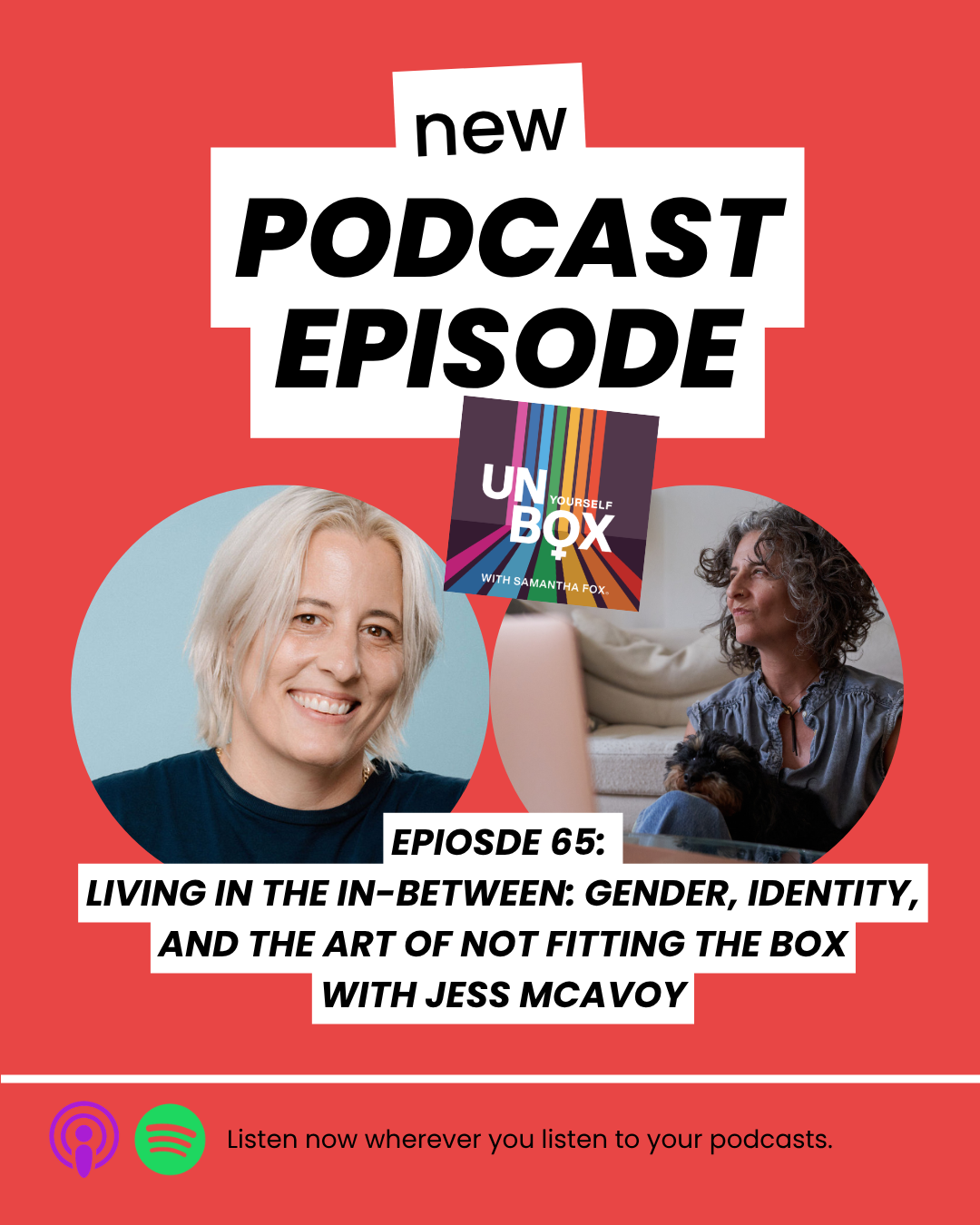
Living in the In-Between: Gender, Identity, and the Art of Not Fitting the Box
We’re told from birth who we should be. By the time we’re old enough to question it, the boxes are already drawn. Male or female. Straight or gay. Butch or femme. Professional or creative. But what if you’re none of these things? What if you’re all of them? What if you’re something that doesn’t have a name yet?
This is the reality Jesse McAvoy has lived for most of their life.
The Space In Between Everything
During a recent Sing Easy event, Jesse’s accessible group singing experience based in New York City, the theme was “the space in between.” It’s a concept that sounds abstract until you really sit with it. We spend our lives chasing arrival. We want to get somewhere, achieve something, feel a certain way. We want to arrive. But the truth is, we’re always in the space in between. Between birth and death. Between one identity and the next. Between who we were and who we’re becoming.
Jesse has spent a lifetime living in that space, and instead of fighting it, they’ve built something beautiful from it.
A Story of Not Fitting In
Jesse’s journey toward understanding their nonbinary identity didn’t happen in a vacuum. It was shaped by concrete experiences of rejection, erasure, and the exhausting work of trying to squeeze themselves into boxes that were never designed for them.
Growing up in Perth, Australia, in the late ’90s and early 2000s, Jesse came of age in a deeply conservative environment. When they moved to Melbourne in their early twenties, they found what they thought would be community, the lesbian bars, the spaces where queer people gathered. But even there, they didn’t fit.
“I got denied entry like more than once because I had long hair and I wasn’t wearing the right shoes,” Jesse recalls. The message was clear: you’re not gay enough. You don’t look the part. You don’t belong here either.
So Jesse turned to music. At least in the music industry, they thought, they could be whatever they needed to be as long as they could play. But that safety was short-lived. Once Jesse came out as a lesbian, the opportunities dried up. They lost gigs. They lost connections. They lost a career path they’d been building.
The price of authenticity was steep.
The Performance of Gender
What’s particularly striking about Jesse’s story is how conscious they became of gender as a performance, not in a way that’s inauthentic, but in a way that’s deeply real. When it became clear that being openly butch in the music industry would tank their career, Jesse did something many of us do-they learned to perform a version of themselves that the world would accept.
“I worked with my friend who was a dance teacher. I worked with a lot of people around clothes and all kinds of stuff to totally dress up what was going on for me,” Jesse explains. They literally studied how to present as straight. How to move. How to dress. How to take up space in a way that wouldn’t threaten the people around them.
This isn’t a failure on Jesse’s part. It’s a survival strategy. And it’s something countless queer and trans people have had to do, consciously or unconsciously, to navigate a world that demands we fit into predetermined categories.
Discovering Nonbinary Identity
It wasn’t until around 2019, as conversations about gender became more public and Jesse began exploring gender as a concept, that things shifted. The term “nonbinary” or “gender nonconforming” finally gave language to something Jesse had always felt: that they existed somewhere in the middle of everything.
“It’s always been a felt sense for me that I sit somewhere in the middle of stuff,” Jesse says. And as they gained clarity around their gender identity, the concept of “the in-between” became central to their work—both as an artist and as a facilitator.
But here’s the thing that doesn’t get talked about enough: living authentically in the in-between doesn’t mean you stop thinking about gender. It doesn’t mean you transcend it. For Jesse, it means being hyperaware of how their presentation affects how people perceive and treat them. It means constant navigation. It means, sometimes, feeling dysphoric and traumatized by a world that still demands you choose a side.
It’s also, Jesse says, “fascinating and annoying, but fascinating.”
The Sing Easy: Building Belonging
Out of all of this, out of the rejection, the loss, the constant negotiation with their own identity, Jesse created something radically generous-the Sing Easy.
It’s structured like a yoga class, moving through exercises that create ease in the body so people can ultimately find harmony with one another. It uses what Jesse calls “spells”, short choruses that repeat so you don’t have to think too hard, just feel. It’s a space designed for beginners, for people who might never have sung in a group before, for people who don’t fit into traditional choir culture.
In other words, it’s a space for the people who didn’t fit anywhere else.
The Sing Easy isn’t just about singing, though the benefits of using your voice are profound. It’s about creating a community where you don’t have to perform, where you can just be, and where belonging isn’t contingent on fitting a particular aesthetic or identity.
It’s the space Jesse never found in the lesbian bar. It’s the safety they couldn’t find in the music industry. It’s what they’re building for everyone else now.
Why the In-Between Matters
In a world obsessed with certainty and categories, Jesse’s insistence on living in the in-between is radical. Not because they’re rejecting identity, they’re not. They’re simply refusing to let identity be a prison.
“Getting rid of nuance is just the way that things are being corroded,” Jesse says. And they’re right. We live in a time of intense polarization, where everything has to be one thing or another. But reality is far messier and more interesting than that. Gender exists on a spectrum. Sexuality exists on a spectrum. Identity itself is fluid.
The in-between isn’t a failure to choose. It’s a refusal to be limited by false choices.
Listen to the Full Conversation
Jesse’s story is one of resilience, creativity, and the hard-won wisdom that comes from never quite fitting anywhere. But there’s so much more to this conversation—including how Jesse uses voice work, creative practice, and embodied tools to process massive life transitions, and what happened when they had a conversation with their own body built out of clay.
Ready to dive deeper into what it means to live authentically in the in-between? Listen to the full episode of Unbox Yourself with Samantha Fox and discover how Jesse transformed a lifetime of not fitting in into something that helps others finally feel like they belong.